How to Price a Bathroom Remodel (Real $42K Example)
Most guides on pricing a remodel give you a square-footage rule of thumb and call it done. That is not how a real bid gets built, and it is not what separates a contractor who makes money from one who breaks even. Here is how I actually price a bathroom remodel, walked through with my own $42,000 Fort Worth job as the running number — including where the bid was right and where the job quietly lost margin anyway.
Price the job in categories, not a lump sum
A lump-sum gut feeling is how contractors lose money. Every bathroom remodel breaks into the same handful of cost categories, and each one needs its own number before you ever add them up. Skip a category and it does not disappear — it just shows up later as a surprise that eats your margin.
- Demo — tearing out the old tub, tile, vanity, and flooring, plus dumpster or haul-off. Cheap to price, expensive to skip: a bathroom with a hidden subfloor problem behind the tile turns a one-day demo into a three-day one.
- Plumbing rough-in— moving or replacing supply lines and drain, especially if the shower or tub is relocating. This is where a sub's bid needs to be firm before you price your own number, not a guess you fill in later.
- Tile and shower— material plus labor for the shower pan, walls, and floor. Tile is the category clients upgrade mid-job more than any other, which is why your bid needs a documented allowance, not just "tile: TBD."
- Vanity and fixtures — vanity, sink, faucet, toilet, mirror, lighting. Easy to underprice because these look like small line items individually and add up fast as a category.
- Electrical— new circuits for a heated floor or fan, GFCI outlets, vanity lighting, exhaust fan. Often subbed out; price the sub's number plus your coordination time, not just the invoice.
- Labor— your own crew's hours, at their real loaded cost (wage plus payroll taxes and comp), not the number on the paycheck.
- Permits — the permit fee itself plus the time it takes to pull it and schedule inspections. Small dollar figure, real hours.
Overhead and margin are their own line, not a hope
Here is the mistake that costs contractors the most money: pricing the categories above, adding them up, and calling that the bid. That total is your cost, not your price. Overhead — insurance, the truck, software, your phone bill, the hours you spend estimating jobs you don't win — has to land on every bid as its own percentage, or you are paying for your business out of a margin you thought was profit.
Margin is the same story. "I'll probably clear around 30%" is not a margin, it is a guess dressed up as a number. A real margin is calculated: total price minus total cost, divided by total price. If you cannot show that math on a bid, you do not actually know your margin — you are finding out for the first time when the job is done, which is exactly what happened to me.
The $42,000 bathroom: how the bid broke down
In 2024 I closed a full bathroom remodel in Fort Worth at a $42,000 contract price. I priced it the way described above — category by category, overhead and margin added on top, targeting roughly 30% margin. Here is an illustrative version of how a bid like that breaks down by category. These are rounded, sensible figures that show how the pieces sum toward a $42,000 job, not a reproduction of the original line-item bid.
| Category | Illustrative bid amount | Share of bid |
|---|---|---|
| Demo | $2,800 | 7% |
| Plumbing rough-in | $6,500 | 15% |
| Tile & shower | $11,000 | 26% |
| Vanity & fixtures | $4,200 | 10% |
| Electrical | $2,500 | 6% |
| Labor (crew) | $8,000 | 19% |
| Permits & fees | $600 | 1% |
| Overhead + profit margin | $6,400 | 15% |
Add the categories and the overhead-plus-margin line and you land close to $42,000. On paper, that bid was built for roughly 30% margin — about $12,600 staying with the company after direct costs. Every category was priced with real numbers, not gut feel. The bid itself was not the problem.
Where the margin actually went
Three months after the job wrapped, my accountant ran the real numbers: 12% margin, not 30%. About $5,000, not $12,600. The gap was $7,500 in costs that never got tracked against the bid while the job was running — lumber runs, fixtures, two Home Depot trips I paid out of pocket and mentally filed under "small stuff." Nothing dramatic went wrong on site. That is what made it dangerous: no blown budget line, no bad sub, just dozens of small, unlogged costs adding up to eighteen points of margin. (I go through the full cost-tracking side of this same job — every category, every leak — in the full cost breakdown of this job.)
This is the piece most pricing advice leaves out. A bid can be priced correctly, category by category, with honest overhead and a real calculated margin, and still lose most of that margin — because pricing a job right and tracking a job right are two different disciplines. Get the first one wrong and you underbid before you start. Get the second one wrong and a good bid quietly bleeds out while you are not looking.
Three pricing mistakes that show up in every bathroom bid
Underestimating small-material trips.A $12 coupling, a $40 fitting, a second trip for the trim kit you forgot — none of these look like they matter when you're pricing the job. They matter when there are thirty of them on one bathroom. Price a contingency line for exactly this, and then actually track against it.
Not pricing overhead into the bid.If overhead is not its own percentage on every job, it is getting paid for out of your margin without you deciding that. The jobs that "should have made money" but somehow didn't are usually jobs where overhead was never priced in the first place.
Guessing margin instead of calculating it."This should clear about 30%" is not a bid, it is a hope. Calculate it: price minus cost, divided by price. Do that math on paper before the job starts, and do it again — with real numbers, not the bid numbers — while the job runs.
Pricing right only works if tracking is real
The fix for my $42,000 job was not a better bid template. The categories were already right. What was missing was a way to see the real number while the job was still running, instead of finding out from an accountant three months later. That is the gap Job Cost Pro is built to close.
AI receipt scanning catches the exact thing that got missed on this job: snap the small material receipt at the counter — the fitting, the trim kit, the second supply run — and it is scanned, categorized, and filed to the job with one tap before you leave the parking lot. No more mentally filing a $40 trip under "small stuff" and forgetting it existed.
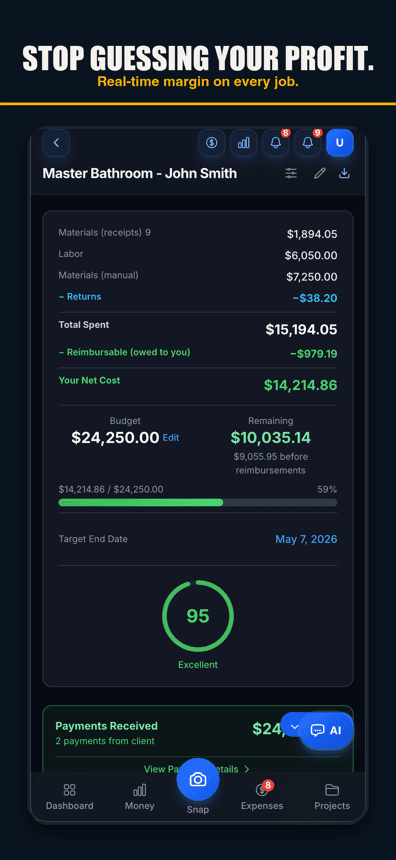
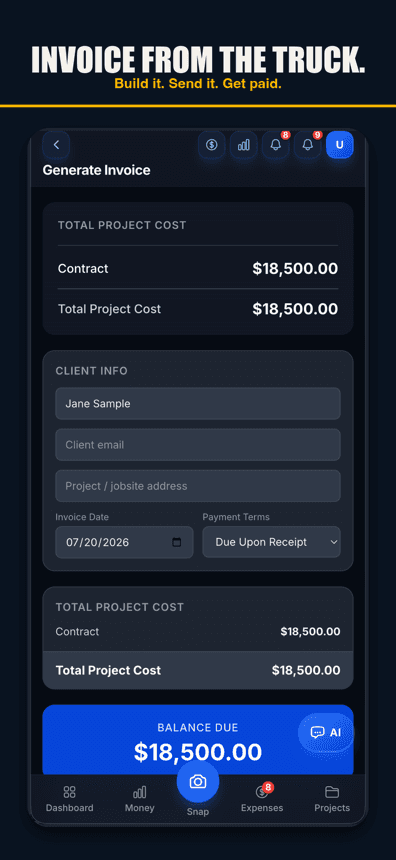
Per-job profit and margin from the costs recorded so far means the number is on your phone during the job, not waiting for tax season. If a job is trending toward 12% instead of the 30% you bid, you see it in week two — while there is still a job left to do something about. And when the work is done, invoicing turns the tracked job straight into a bill, so the numbers you priced, tracked, and billed are all the same numbers.
Live margin while the job runs, and an invoice built from the real numbers
For more on our guide to job costing, and specifically the read on this same job, see our job-costing guide.
A simple way to price your next bathroom
- Price demo, plumbing rough-in, tile/shower, vanity/fixtures, electrical, labor, and permits as their own line items — real numbers, not a lump guess.
- Add overhead as its own percentage, not folded quietly into the categories above.
- Calculate margin — price minus cost, divided by price — instead of estimating it.
- Track every real cost against the bid while the job runs, especially the small material trips, so the margin you calculated on paper is the margin you actually keep.
Job Cost Pro is free on the App Store — 3 projects, 50 receipts a month, full AI scanning. No credit card. Get it here.
Track your next job with Job Cost Pro
Scan receipts, confirm the suggested job, and see your recorded costs against your budget. Start with the free plan in your browser or get the iPhone app.
Free plan available. Some features require a paid plan.
FAQ
How do you price a bathroom remodel?
Price it category by category — demo, plumbing rough-in, tile/shower, vanity and fixtures, electrical, labor, and permits — then add overhead as its own percentage and a calculated profit margin on top. Adding up categories without pricing overhead and margin separately is how bids come in short.
What is a good profit margin on a bathroom remodel?
Many contractors target around 30% on a remodel bid. The number matters less than whether you calculate it (price minus cost, divided by price) and then track actual costs against the bid while the job runs — a well-priced 30% margin job can still land at 12% if small costs go untracked.
What categories should a bathroom remodel bid include?
Demo, plumbing rough-in, tile and shower, vanity and fixtures, electrical, labor, permits, and — as their own line — overhead and profit margin. Each category needs its own number; a single lump-sum guess is where bids go wrong.
Why do bathroom remodel bids come in under the real cost?
Usually not because the bid categories were wrong — because small material costs (a fitting, a trim kit, a second supply-house trip) never get tracked against the bid once the job starts. On a real $42,000 bathroom remodel, $7,500 in exactly these small, untracked costs turned a bid margin of 30% into an actual margin of 12%.
How much did a real $42,000 bathroom remodel actually make?
The bid targeted roughly 30% margin, about $12,600. The actual margin came back at 12%, about $5,000, after $7,500 in small material costs — lumber runs, fixtures, two supply-house trips — never got captured against the job while it was running. The bid was right; the cost tracking was not.
Should overhead be included when pricing a remodel?
Yes, as its own line — a fixed percentage on every bid, not something absorbed into the category prices. Skipping it means your business overhead gets paid for out of a margin you assumed was profit.