How Lien Waivers and Job Costing Work Together
Most contractors treat lien waivers as a form you sign because the GC or the title company asked for one. Sign it, forget it, move on. That works fine right up until a payment dispute, a bounced check, or a change order that never made it onto anybody's books — and then the waiver you signed months ago becomes the document everyone is arguing about. The paperwork only holds up if the numbers behind it were right in the first place, and the numbers behind it are your job costing.
What a lien waiver actually is
A mechanic's lien is a legal claim a contractor, sub, or supplier can place against a property when they perform work or supply materials and don't get paid for it. It gives unpaid parties a way to force the issue — the lien clouds the title, and it can hold up a sale or a refinance until the debt is settled. It exists to protect the people who show up and do the work.
A lien waiver is the flip side of that protection. When you sign one, you're telling the property owner or the GC: "I've been paid for this work (or I will be, once this check clears), and I'm giving up my right to lien this property for it." Owners and GCs ask for waivers before releasing payment because the waiver is what proves, on paper, that the money changed hands and the lien risk on that portion of the work is closed out.
On most jobs of any size, waivers aren't a one-time thing at closeout — they get collected at every draw or progress payment, from the GC down through every sub and supplier who touched the job. Miss one, and the title company or lender can hold the whole draw.
The four kinds of waivers, in plain English
Waivers split along two lines: whether payment has actually cleared, and whether it's covering part of the job or all of it.
| Type | Takes effect when | Covers |
|---|---|---|
| Conditional partial | The payment for this specific draw actually clears. | One progress payment, not the whole job. |
| Unconditional partial | The moment you sign it — no wait for funds to clear. | One progress payment, not the whole job. |
| Conditional final | The final payment clears. | The entire job, once that last check is good. |
| Unconditional final | The moment you sign it. | The entire job — full and final, no strings attached. |
The practical read: "conditional" is the safer one to sign, because it only bites if the money is actually good. "Unconditional" is the one that should make you stop and double-check your own numbers first, because you're giving up your lien rights the second you sign — before, not after, you know the check is real. Some states require specific statutory waiver forms with exact language; using the wrong form or the wrong type for the situation can create problems that have nothing to do with job costing at all. That's the kind of detail to run past a construction attorney, not a blog post.
Where job costing comes in
Here's the part that gets skipped. A waiver is a factual statement: "I have been paid $X for this work, on this job, as of this date." Signing it — or asking a sub to sign it — is only honest if you actually know what $X is. That number has to come from somewhere. If it's coming from memory, a gut feeling, or "the bank account looks about right," you're signing a legal document off a guess.
This is exactly what job costingis for — tracking what a specific job was invoiced, what was actually collected, and what change orders changed along the way. A waiver and a job cost record are supposed to say the same thing. When they don't, that mismatch is where the real trouble starts:
- You sign a final waiver, then find a change order that was never invoiced. Now you've waived lien rights on work you were never paid for, because nobody's records caught the gap before the pen hit paper.
- A sub asks you for a waiver covering "the whole job" when they only got paid for two of three draws.If your job records don't separate draws cleanly, it's easy to hand over — or accept — the wrong scope of waiver by accident.
- A payment gets applied to the wrong job. If two jobs are running at once and a deposit lands in the general account without a clear job tag, you can end up swearing a job was paid in full when the money that cleared was actually for a different address.
- A partial payment gets treated like a final one.Sloppy records blur the line between "paid to date" and "paid in full," and that line is the entire difference between a partial waiver and a final one.
None of these are legal-drafting problems. They're bookkeeping problems that turn into legal problems the moment a signature gets attached to them. Clean, per-job records don't replace legal advice on the waiver itself — but they're what keep the facts inside that waiver true.
Payment records tied to the right job
The fix isn't complicated, it's just specific: every invoice and every payment needs to be tied to one job, not to "the business" in general. When you can pull up a single job and see, at a glance, exactly what was invoiced against it, exactly what's been collected, and what's still outstanding — you can sign a waiver, or ask for one, with a straight answer instead of a guess.
That means invoices that reference the specific job and draw, payment status that updates per job instead of living in a general ledger somewhere, and change orders that get added to that job's numbers the day they're agreed to, not weeks later when someone remembers. In Job Cost Pro, invoicing (sending is on Pro and up) and the client portal (every plan) work this way by default: you generate and send an invoice for a specific job from the phone, the client sees it on their own page with your bank or check details, and every payment you record is tracked against that job — not a blended total. Pair that with per-job profit from the costs recorded so far (labor, materials, and subs rolled up against what's actually been billed and collected) and you're looking at the same numbers a lien waiver is supposed to represent, in real time, on the job in question.
An invoice built for one job — the same job the waiver covers
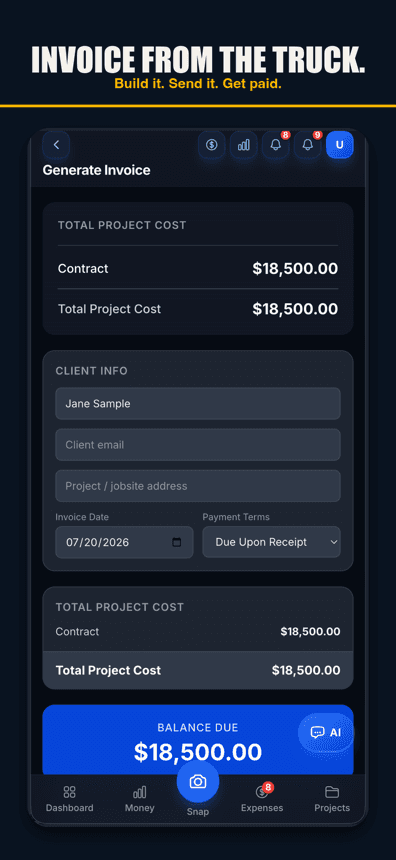
This is the same discipline covered in our invoicing guide— an invoice that clearly states the job, the draw or milestone, and the amount is the paper trail that makes the waiver an easy, honest signature instead of a leap of faith. And it works in both directions: if you're the one requesting a waiver from a sub, your own job costing tells you whether what they're claiming lines up with what you actually paid them.
A simple habit that prevents most of the mess
Before signing or requesting any waiver, pull up that specific job and check three things: what was invoiced, what has actually cleared, and whether any change orders from the last few weeks made it onto the job's numbers yet. If those three line up with what the waiver claims, sign it. If they don't, stop and find out why before you sign — not after.
That habit costs a couple of minutes per waiver. Chasing down a lien dispute, or discovering you signed away rights to money you were never actually paid, costs a lot more than that — in time, in legal fees, and in the relationship with whoever's on the other side of the paperwork.
When to bring in a professional
Lien law is state law, and it varies more than most contractors expect — required statutory forms, filing deadlines, notice requirements, and what a waiver actually binds you to are all state-specific. Nothing in this article is legal advice, and it isn't a substitute for it. If a job involves real money, a dispute is brewing, or you're unsure whether a waiver you're about to sign says what you think it says, talk to a construction attorney or the title company handling the closing before you sign anything final. Clean job costing gets you to that conversation with the right facts in hand — it doesn't replace the conversation.
Job Cost Pro is free on the App Store — 3 projects, 50 receipts a month, full AI scanning. No credit card. Get it here.
Track your next job with Job Cost Pro
Scan receipts, confirm the suggested job, and see your recorded costs against your budget. Start with the free plan in your browser or get the iPhone app.
Free plan available. Some features require a paid plan.
FAQ
What is a lien waiver in construction?
A document where a contractor, sub, or supplier gives up their right to file a mechanic’s lien on a property, usually in exchange for payment. It’s the proof, on paper, that a specific payment closed out the lien risk tied to that work.
What is the difference between a conditional and unconditional lien waiver?
A conditional waiver only takes effect once the payment actually clears — if the check bounces, the waiver never took hold. An unconditional waiver takes effect the moment you sign it, whether the money shows up or not, which is why it deserves a closer look at your own records before signing.
Why does job costing matter for lien waivers?
A waiver is a factual claim about what has been paid on a specific job. If your job costing does not clearly show what was invoiced and collected on that job, you cannot honestly confirm the claim you are signing — you are just guessing, and a lien waiver is not the place to guess.
What is the difference between a partial and a final lien waiver?
A partial waiver covers one payment or draw, not the whole job — you can still have lien rights for the remaining work. A final waiver covers the entire contract, once the last payment is accounted for. Mixing the two up, usually from unclear payment records, is a common and avoidable mistake.
Do lien waiver rules vary by state?
Yes, significantly — some states require exact statutory waiver forms and language, and filing deadlines and notice requirements differ widely. This article is general education, not legal advice; check with a construction attorney or title company for what applies to your state and your job.
Can invoicing software help with lien waiver accuracy?
It helps with the input, not the legal document itself. Invoicing and payment tracking tied to a specific job — like the per-job invoicing and client portal in Job Cost Pro — gives you a clear, current answer to “what has actually been paid on this job,” which is the fact a lien waiver is supposed to represent.