Concrete Job Costing: Driveways, Slabs, Foundations
Concrete work has a margin problem most other trades do not deal with the same way: the biggest line item on your bid — the mix itself — can cost more on pour day than it did when you quoted the job. Add in overage you can not always avoid, forms and rebar labor that gets lumped in with "the pour" instead of tracked on its own, and a rain delay that pushes a crew a full day, and a driveway that should have made 25% limps in at 10%. None of that shows up until you actually separate the costs. That is what job costing does, and concrete is one of the trades that needs it most. If the term itself is new to you, our job-costing guide covers the basics before you dig into the concrete-specific parts below.
Why concrete margins move more than other trades
Framing lumber and drywall prices drift week to week. Ready-mix pricing can move between the day you bid and the day the truck shows up, and a lot of batch plants quote by the load, not by a locked contract price. A driveway bid built on last month's per-yard number can already be underwater before the first truck backs up the driveway. If you are not tracking actual material cost per job — not an estimate, the real invoice — you find out you were wrong three weeks after the crew is gone, which is too late to do anything but eat it.
The fix is not guessing better. It is capturing the batch ticket the day it happens and tying it to that specific job, so your running cost total reflects what the pour actually cost, not what you assumed it would.
Waste and overage: the margin-killer nobody bids for
Every pour has some waste built in — form leaks, a slab that runs a little thick, a truck that shows up with a partial load you still pay a short-load fee on. Order too light and you are paying for a second truck and a cold joint you did not want. Order heavy "to be safe" and you are paying for yards that went into the ground for nothing. Either way it is real money, and on a job bid at a tight per-yard margin, overage is often the difference between profit and a wash.
The only way to see it is to track ordered yards against billed yards, job by job, and watch the pattern. If your driveway jobs are consistently running 8–10% over on material, that is not bad luck — that is a number you can build into the next bid, or a sign your crew's forming needs tightening up.
Forms, rebar, and labor need their own line — not "the pour"
A lot of contractors cost a concrete job as one lump: "concrete — $6,200." That number hides more than it tells you. Forming and rebar setting is labor-heavy and can eat two or three days before a truck ever shows up. The pour itself might be four hours. Finishing and cure-time babysitting is its own chunk of time again. If all of that gets logged as one bucket, you cannot tell whether you lost money on the mix, on the crew hours forming up a tricky foundation wall, or on a pump-truck rental you forgot to bill back. Split it — forms and rebar labor, pour-day labor, material (batch tickets), equipment and job-specific fees (pump truck, saw-cutting subs, permits) — and the next bid gets sharper because you know exactly which piece ran hot.
Weather delays cost real money, and most contractors never write it down
A rained-out pour day is not free. The crew still needs paying if they showed up and got sent home, forms sitting exposed can need rework, and a rescheduled pour means another trip charge from the batch plant on some contracts. None of that gets billed to the client on most jobs, which means it comes straight out of your margin — but only if you actually track the hours and costs tied to the delay. Contractors who do not log weather days as a real cost on the job tend to blame "a rough season" instead of seeing it plainly: three delayed pours this spring cost about a day and a half of crew labor each, and that is a number worth knowing before you bid the next foundation job in a wet month.
How to actually track it without slowing the crew down
None of this works if it depends on someone typing batch tickets into a spreadsheet Sunday night. The batch ticket needs to become a job cost the moment the truck leaves, not three weeks later when half of them are gone missing from a truck console. With Job Cost Pro, you photograph the ticket at the plant or on site and AI reads the vendor, yardage, and price straight onto the job — no re-typing a delivery ticket at a desk. Hands full of rebar or forms? Say the cost out loud and voice-to-expense logs it for you, in English or Spanish, so the guy setting rebar does not have to stop and pull out a phone keyboard. (Voice works in browsers with speech input, like Chrome and Safari, and in the iPhone app on version 1.0.8 or newer.)
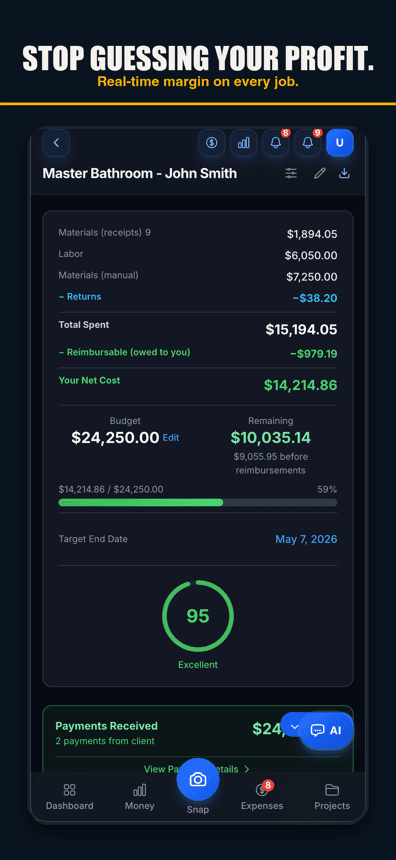
Job-specific fees — pump-truck rental, saw-cutting subs, permits — get tagged to the same job instead of disappearing into a general expenses account, so when you close out the driveway you can see the whole cost stack: material, forms/rebar labor, pour-day labor, equipment, fees. And because real-time margin trackingupdates as each cost lands, you see the job's actual margin sliding while you can still do something about it — add a change order for the extra yardage, or at minimum know for the next bid.
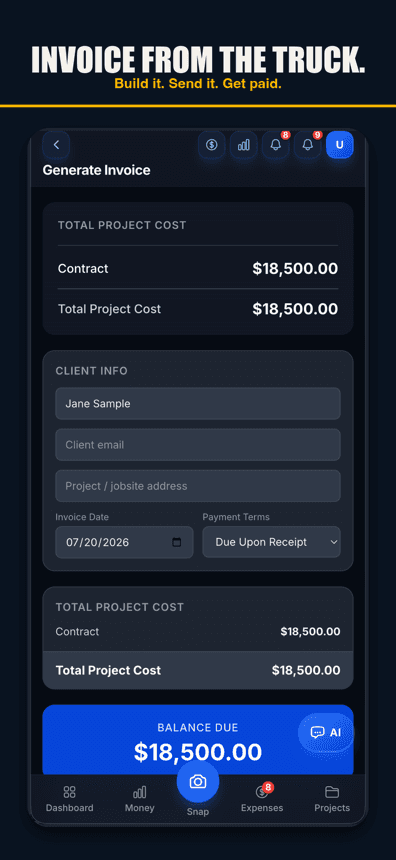
Live margin on the job, and a fast invoice for the extra yardage
What it caught on my own jobs
I run Job Cost Pro because I needed it myself. On a $42,000 remodel a few years back, I figured I'd cleared about 30% margin — that was the bid. The real number, once every receipt got counted, was 12%. $7,500 in small stuff I never wrote down: lumber runs, fixtures, trips I paid for out of pocket and forgot about by the time the job closed. Concrete has the same trap with a shorter fuse — a mix-price jump or a load of overage can move the needle just as fast, and it happens on pour day, not spread out over a six-week remodel. The habit that fixes it is the same either way: capture the cost the moment it happens, not from memory later.
The bottom line for concrete contractors
Track material cost by the actual batch ticket, not the bid estimate. Track ordered yards against poured yards so overage stops being invisible. Keep forms/rebar labor, pour-day labor, and equipment/fees as separate lines instead of one lump called "concrete." And write down weather delays as a real cost, because they are one. Do that job after job and your bids start matching what the work actually costs — which is the whole point of job costing in a trade where the price of your main material can change between the bid and the pour.
Job Cost Pro is free on the App Store — 3 projects, 50 receipts a month, full AI scanning. No credit card. Get it here.
Track your next job with Job Cost Pro
Scan receipts, confirm the suggested job, and see your recorded costs against your budget. Start with the free plan in your browser or get the iPhone app.
Free plan available. Some features require a paid plan.
FAQ
How do I job cost a concrete driveway or patio?
Track four buckets separately: material by the actual batch ticket (not the bid estimate), forms and rebar labor, pour-day labor, and equipment/fees like a pump truck or saw-cutting sub. Add those to job-specific costs like permits, then compare the total to what you billed to see your real margin on that pour.
Why does my concrete job never make the margin I bid?
Three usual causes: ready-mix pricing moved between the bid and the pour, waste/overage ran higher than planned, or weather delay hours never got written down as a cost. All three are invisible unless you track actual costs per job instead of comparing the bid to your bank balance.
How much concrete overage should I expect on a pour?
It varies by job and crew, but the only way to know your real number is to track ordered yards against poured yards job by job. If you are not measuring it, you cannot tell whether 5% waste is normal for your crew or a forming problem worth fixing.
Should weather delays be tracked as a job cost?
Yes. A rained-out pour day still costs crew hours, possible form rework, and sometimes a rescheduling fee from the batch plant. If that time is not logged against the job, it silently eats your margin instead of showing up as a number you can plan around next time.
What is the easiest way to track concrete costs in the field?
Capture the cost the moment it happens instead of reconstructing it later. Job Cost Pro lets you photograph a batch ticket or invoice and AI reads the vendor, yardage, and price and suggests the job when the ticket names it or you scan at the jobsite — one tap files it, or you can say the cost out loud with voice-to-expense when your hands are full of forms or rebar.