Fixed-Price vs Cost-Plus Contracts: Which Protects Your Margin?
Every contractor has a gut answer to "which contract type is better," and it is usually whichever one burned them last. That is not a strategy. Fixed-price and cost-plus are tools for different jobs, and picking the wrong one is how a profitable crew ends up working for free on a job that looked fine on paper.
Fixed-price, plainly
Fixed-price is the contract most homeowners expect: you quote one number for the defined scope, they sign, and that is the price — regardless of what it actually costs you to deliver. If lumber jumps 20% mid-job, that is your problem. If you find rot behind a wall that was not in the scope, that is a change order, but everything you did account for is locked at your number.
The client likes fixed-price because it is simple to understand and simple to budget against. There is no surprise invoice at the end. From your side, the appeal is just as real: nail the estimate and every dollar of savings under that number is yours to keep. Come in lean and efficient, and fixed-price rewards you for it directly.
The catch is the word "nail." Fixed-price only works in your favor when your estimate is close to right. Every dollar you miss on the bid comes straight out of your pocket, not the client's. A scope you can see, measure, and price with confidence — new construction on a clean lot, a kitchen with no structural unknowns, a driveway pour — is where fixed-price is the right call. You are pricing what you can actually predict.
Cost-plus, plainly
Cost-plus flips the risk. The client pays what the job actually costs — labor, materials, subs, permits, the real numbers — plus an agreed fee or percentage on top for your overhead and profit. If costs run higher than either of you expected, the client absorbs it, not you. Your margin, expressed as that fee, is protected no matter what the job throws at you.
That protection is the whole appeal for the contractor. Behind-the-wall surprises, supply-chain price jumps, a scope that grows because the client keeps adding — none of it eats your fee. You are not gambling on an estimate you made before demo day; you are billing what actually happened.
But cost-plus is not a free pass, and treating it like one is how contractors torch the trust that makes the model work in the first place. In a cost-plus arrangement the client is, by design, paying your real cost. That means they can ask to see it — and a client who is paying a percentage on top of your numbers has every right to expect those numbers to be accurate, current, and defensible. Cost-plus does not remove the pressure to track costs well. It relocates it: instead of pressure to guess right on a bid, it is pressure to record right, every single day, because the client is looking at the same ledger you are.
Side by side
| Fixed-Price | Cost-Plus | |
|---|---|---|
| Who eats an overrun | You do | The client does |
| Price certainty for client | Total, before work starts | Estimated range, final number depends on actual cost |
| Best fit | Well-defined scope, few unknowns | Remodels, renovation, anything with hidden conditions |
| What protects your margin | An accurate bid, made once | Airtight job costing, maintained every day |
| What the client can audit | Nothing — the price was fixed | Your actual costs, since their bill is built on them |
| Where it breaks | You underbid the unknowns | Your tracking is sloppy and the numbers don’t hold up |
Why remodel work leans cost-plus
New construction on a slab you are pouring yourself is a scope you can see in full before you swing a hammer. Renovation and remodel work is the opposite: you do not know what is behind that wall until it is open. Old wiring, water damage nobody disclosed, a floor joist that is not where the plans say it is — these are not hypothetical line items, they are the normal texture of remodel work. Bid that kind of job fixed-price and you are pricing in a guess about how much bad news you will find, then hoping you guessed high enough.
Cost-plus removes the guess. You do not have to price the unknown — you bill it when it shows up, with the receipt to back it. That is a fairer deal for both sides on a job where nobody, including you, can fully see the scope on day one. It is also why so many experienced remodelers migrate toward cost-plus as their default for renovation work even when they still quote new builds fixed-price.
The condition nobody puts on the sales page: your job costing has to be airtight
Here is the part contractors skip past when they get excited about cost-plus: the whole model depends on your cost tracking being good enough to survive a client actually looking at it. On a fixed-price job, your job costing is for you — a client never sees the internal number, because the internal number does not change what they owe. On a cost-plus job, your job costing is the invoice. The client is not paying a price you made up in advance. They are paying your real cost, plus your fee, and that real cost has to be real.
Sloppy tracking on a cost-plus job cuts two ways, and both are bad. Miss receipts — the $38 fitting, the second supply run, the rental you paid cash for — and you are not overcharging the client, you are undercharging yourself. Those missed costs come straight off your fee, because you cannot bill what you never recorded. That is the same leak that guts a fixed-price bid, except on cost-plus it happens silently, invoice after invoice, and it never shows up as a single bad number you can point to.
The other direction is worse. If your records are thin, late, or inconsistent, a careful client is going to notice — and a client who is paying a percentage on top of your numbers is entitled to ask hard questions about numbers that do not hold together. A cost-plus relationship runs on trust, and trust runs on your ability to show, line by line, exactly what the job cost and when it cost it. That is not paperwork for its own sake. It is the thing that keeps the client comfortable enough to keep signing your change orders instead of shopping your invoice against three competitors.
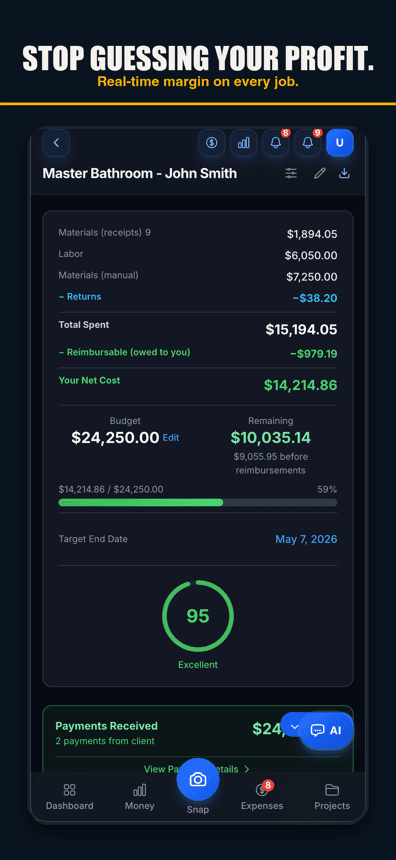
This is where Job Cost Pro earns its keep on a cost-plus job specifically. AI receipt scanning captures every cost the moment it happens — at the supply-house counter, not reconstructed from memory on a Sunday night — so the record a client eventually sees is the same record you built in real time, not a version cleaned up after the fact. And because per-job profit and margin so far update as costs land, you can show the client the real number whenever they ask, instead of promising to get back to them.
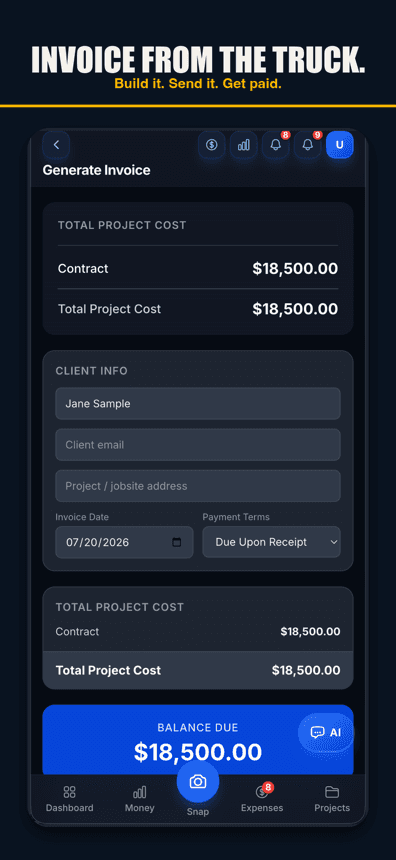
Live margin on one side, the billed invoice on the other
How to choose for a specific job
- Can you see the whole scope before you start? New construction, a clean install, a job with no walls to open — fixed-price lets you keep every dollar you save on an accurate bid.
- Is there real risk of hidden conditions?Renovation, remodel, any job where "we won't know until we open it up" is a true sentence — cost-plus keeps you from eating a surprise you could not have priced.
- Can you track costs well enough to defend them? If the honest answer is no, fix that before you sign a cost-plus contract, not after the client asks a question you cannot answer.
- Does the client want to see the numbers, or want a number? Some clients want the transparency and are fine with a range. Others want one price and do not want to think about it again. Read the client, not just the job.
None of this means picking a lane forever. Plenty of contractors run fixed-price on new builds and cost-plus on remodels, sometimes in the same month, because the two contract types are answering different questions: how well can I predict this, and how much does the client want to see. Know which question a given job is actually asking before you decide how to bill it.
If you choose cost-plus, here is the tool for it
Deciding to run a job cost-plus is a pricing decision. Running a cost-plus job well is an operations problem — you need every cost captured, tagged to the job, and ready to show a client without a scramble. That is a separate need from the choice itself, and it is worth solving before you send the first invoice. If cost-plus is the fit for your next job, our cost-plus invoicing page walks through the practical side: how the billing actually gets built from your tracked costs and handed to the client.
And if you want the fuller picture on the tracking half — what job costing is, what it should include, and how contractors actually keep up with it in the field — our job-costing guide is the place to start.
The bottom line
Fixed-price protects the client from a surprise bill and protects you if you bid well. Cost-plus protects your margin from a job you cannot fully see and protects the client with visibility into what they are paying for. Neither one is the "right" answer in the abstract — the right answer is whichever one matches how well-defined the job in front of you actually is, and whether your cost tracking is strong enough to back up the number you are about to bill.
Job Cost Pro is free on the App Store — 3 projects, 50 receipts a month, full AI scanning. No credit card. Get it here.
Track your next job with Job Cost Pro
Scan receipts, confirm the suggested job, and see your recorded costs against your budget. Start with the free plan in your browser or get the iPhone app.
Free plan available. Some features require a paid plan.
FAQ
What is the difference between fixed-price and cost-plus contracts?
Fixed-price is one agreed number for the whole job — the contractor eats any overrun, and the client has price certainty. Cost-plus means the client pays the contractor’s actual cost plus an agreed fee or percentage, so the contractor’s margin is protected from surprises but the client can see and audit the real costs behind the bill.
Which contract type is better for a contractor?
Neither is universally better — they protect against different risks. Fixed-price rewards an accurate bid on a scope you can fully see. Cost-plus protects your margin on a job with real unknowns, but only if your job costing is accurate enough for the client to trust what they’re being billed.
When should I use cost-plus instead of fixed-price?
Cost-plus fits jobs with real hidden-condition risk — renovation and remodel work where you cannot see the full scope until walls are open. Fixed-price fits well-defined scope, like new construction on a clean lot, where you can price what you can actually predict.
Does cost-plus mean the client can see all my costs?
Yes, by design. Cost-plus billing is built on your actual cost plus a fee, so the client is paying real numbers and can reasonably expect to see them. That is the trade-off: your margin is protected from overruns, but your books have to be accurate enough to hold up to a client looking at them.
Is cost-plus riskier than fixed-price?
It shifts the risk rather than removing it. Fixed-price risk is bidding wrong. Cost-plus risk is tracking wrong — miss receipts and you undercharge yourself, keep sloppy records and a client may start questioning invoices they are entitled to audit. Airtight job costing is what makes cost-plus work in your favor instead of against you.
Can I use both contract types in the same business?
Yes, and many contractors do — fixed-price for scope they can fully define upfront, cost-plus for renovation and remodel work with real unknowns. The two types answer different questions, so the right choice can change job by job.