Roofing Job Costing: Stop Guessing on Materials
Roofing is one of the hardest trades to job-cost honestly, and one of the easiest to get wrong quietly. A kitchen remodel drags on for weeks and everyone knows the costs are piling up. A roof gets done in a day or two, gets paid, and moves off your mental radar — right as three more receipts for that job are still sitting in somebody's truck console. By the time you notice a pattern, you have already bid the next twenty roofs the same wrong way.
The takeoff is not the job cost
Every roofer knows how to run a takeoff — squares, bundles, rolls of underlayment, linear feet of flashing and drip edge. The math on paper is clean. The math on the roof never is. A steep pitch chews through extra shingles you did not plan for. A roof with eight hips and valleys wastes material a simple gable roof never would. A supply house that is out of your exact shingle color sends you home with a different batch number and a return trip nobody billed to the job.
None of that shows up in the estimate. It shows up in receipts — and receipts only tell the truth if they get tracked against the specific roof they belong to, not lumped into a general materials bucket for the month. If you are buying for three roofs in one supply run, and the receipt gets tagged to whichever job you think of first, you are not job costing. You are guessing with extra steps.
Labor across multiple roofs in a day
A remodeling crew usually works one job at a time. A roofing crew might tear off and dry-in one roof in the morning and start a second job that afternoon, or run two smaller crews on two roofs at once. Every hour has to land on the right job, or your per-roof labor cost is a guess dressed up as a number. A crew that quietly runs long on a tricky tear-off eats into the next roof's schedule and its own job's margin — but only if somebody is actually splitting the hours by job instead of writing "roofing crew, Tuesday" on a time sheet and calling it done.
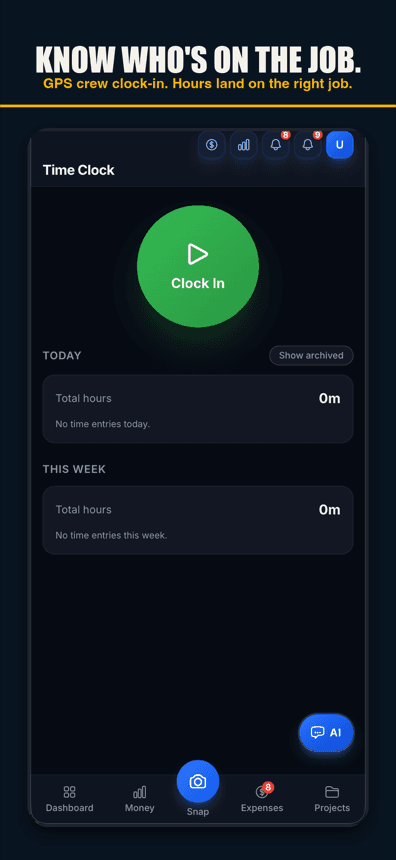
This is where Job Cost Pro earns its keep for roofers specifically: a one-tap GPS prompt clocks the crew in and out on whichever jobsite they are physically standing on — and on the Contractor tier a crew member can opt in to automatic clock-in, after a location disclosure, for the mornings nobody wants to fumble with a phone. Nobody has to remember to swap the job on a time clock between the morning tear-off and the afternoon install.
Weather delays blur which costs belong to which job
A roof that should take two days can stretch to two weeks once you factor in rain delays, a tarp-and-wait stretch, or a crew pulled off to cover an emergency leak somewhere else. The job drags, but your tracking usually does not stretch with it. Materials bought in week one, a return trip for extra ridge cap in week two, a dumpster swap because the first one filled with tear-off debris before the delay even started — all of it needs to land on that one job's running total, not get absorbed into "this month's material costs" where it quietly dilutes every other roof's numbers.
The longer a job sits open, the more it depends on someone remembering which receipt went where. That is exactly the kind of memory that fails. A roof that got rained out twice and finished three weeks late is the roof most likely to have real margin, and least likely to have anyone go back and check.
Permits, dumpsters, and disposal fees eat margin quietly
Tear-off debris has to go somewhere, and disposal is not free. A permit fee, a dumpster rental, an extra dump run because the first bin filled faster than expected on a heavier tear-off than the bid assumed — none of these show up in a shingle takeoff, and none of them are big enough on their own to trigger alarm bells. But they hit every single roof, and they are exactly the kind of job-specific fee that gets absorbed into general overhead instead of charged against the job that actually generated them.
Job-specific fee tracking exists for precisely this reason. A permit, a dumpster, an equipment rental for a lift on a steep-pitch job — each one gets tagged to the job it belongs to, so it shows up in that job's real cost instead of getting buried in a company-wide expense line that nobody reads until tax season.
A roof's real margin, not the bid margin
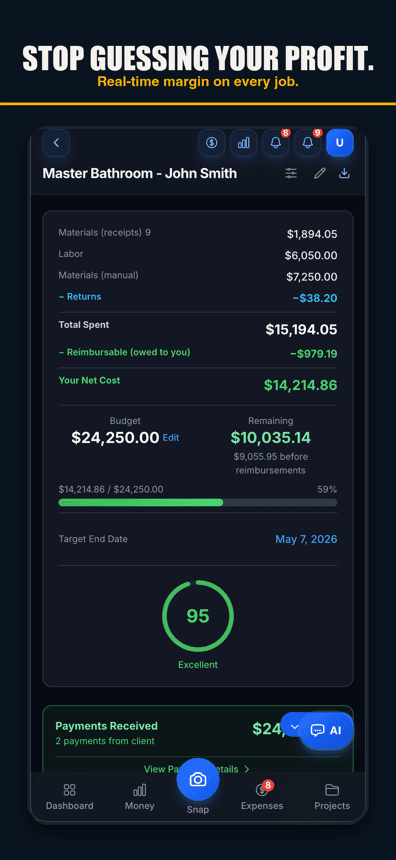
What real-time margin catches on a roof that a monthly report cannot
The value of per-job profit from the costs recorded so far on a roof is timing. A roof that is bleeding margin because of a bad material return, an unexpected second dumpster, or labor running long shows up in the job's numbers while the crew is still on the ladder — not three months later when your accountant hands you a P&L that pools every roof you ran that quarter into one number. By then you cannot fix that roof. You can only find out it happened.
I learned this lesson on a remodel, not a roof, but the mechanics are identical: a $42,000 bathroom job I figured was running around 30% margin actually landed at 12% — $7,500 in receipts I never wrote down. Small receipts, spread across the job, none of them individually alarming. A roofing job has the same failure mode, just compressed into fewer days and split across more crews at once. See our job-costing guide for the full breakdown of how that gap adds up on any trade.
How to actually job-cost a roof
- Photograph every material receipt at the counter, tagged to the job. AI receipt scanning reads the vendor, items, and price off the photo and suggests the job when the receipt names it (or you scan at the jobsite) for a one-tap confirm — including the return trip for extra ridge cap that a spreadsheet would never catch.
- Split crew labor by jobsite, automatically.GPS geofence clock-in means the tear-off crew's morning hours and the install crew's afternoon hours land on two different roofs correctly, with nobody doing the math by hand.
- Tag every fee to the job that caused it. Permits, dumpsters, equipment rental — each one attached to the specific roof, not absorbed into overhead.
- Watch margin while the job is still open. A roof stretched by weather delays needs its running cost checked mid-job, not after the final invoice goes out, because that is the only point where you can still do something about it.
Why this matters more for roofing than most trades
Roofing runs on thinner timelines and tighter margins than a lot of remodeling work, which means there is less room for a forgotten receipt or a mis-tagged labor hour to hide. And because roofs finish fast, the temptation to skip the tracking is strongest exactly when the cost of skipping it is highest. The roofers who know their real numbers bid the next roof correctly. The ones who only know the bid number keep repeating whatever mistake ate last quarter's margin, without ever seeing it. Real-time margin tracking is what turns that blind spot into a number you can act on before the job closes.
Pricing
| Tier | Price | What you get |
|---|---|---|
| Free | $0 | 3 projects, 50 receipts/mo, full AI receipt scanning |
| Pro | $29.99/mo | Higher limits for a growing roofing operation |
| Contractor | $49.99/mo | GPS Geofence Auto Clock-In/Out for crews across multiple jobsites in a day |
Job Cost Pro is free on the App Store — 3 projects, 50 receipts a month, full AI scanning. No credit card. Get it here.
Track your next job with Job Cost Pro
Scan receipts, confirm the suggested job, and see your recorded costs against your budget. Start with the free plan in your browser or get the iPhone app.
Free plan available. Some features require a paid plan.
FAQ
How do I job cost a roofing job?
Track every material receipt against that specific roof (not a general materials bucket), split crew labor by jobsite when a crew works more than one roof in a day, tag permits/dumpster/equipment fees to the job that caused them, and check the running margin while the job is still open — not after the final invoice.
Why does roofing material cost always run over the estimate?
Takeoffs are calculated on paper — squares, bundles, linear feet. Real roofs waste more on steep pitches, complex hips and valleys, and mismatched supply-house batches that trigger a return trip. That overage only shows up if every receipt is tracked against the job, not averaged across the month.
How do you track labor when a crew works multiple roofs in one day?
Manually, on a time sheet, it usually gets written as one block and split by guess. A GPS-geofenced jobsite clock — a one-tap prompt by default, or opt-in automatic clock-in — attaches each hour to whichever jobsite the crew is physically standing on, so a morning tear-off and an afternoon install land on two different jobs correctly.
Do permit and dumpster fees really affect roofing margin that much?
Individually, rarely enough to notice. Every roof, every time, they add up. Because none of them are large enough to trigger alarm on their own, they are the classic cost that gets absorbed into general overhead instead of charged to the job that generated them — which quietly understates every roof’s real cost.
How does a weather delay affect job costing on a roof?
A roof that should take two days can stretch to two or three weeks with rain delays and crew pulls. Every cost still has to land on that one job — a return material trip, a swapped dumpster, extra labor days — but the longer a job stays open, the more that tracking depends on memory instead of a system, which is exactly where it tends to fail.
What is the best way for a roofing company to track job profit?
Per-job margin from the costs recorded so far, not a quarterly P&L. A quarterly report pools every roof you ran together, so one job bleeding margin gets buried in the average. Live tracking shows that specific roof’s numbers while the crew is still on it, which is the only point where you can still act on what you see.