Job costing for electrical contractors
Copper Moves Fast. Your Job Costs Should Keep Up.
Electrical jobs bleed in specific places: wire bought across three supply runs, the breaker that came back, the inspection trip nobody billed, and the licensed-versus-helper hour mix that decides whether the rough-in made money. This app tracks all of it per job, from the field, and shows the margin from the costs recorded so far while the job is still open.
Free forever — 3 projects, 50 receipts a month. No credit card.
The material ran fine. The margin didn’t.
A panel upgrade gets priced tight because the market is tight. Then copper moves between quote and purchase, the second supply run adds forty minutes and $180, and the inspector wants one more trip. None of it is dramatic; all of it is margin. Shops that job-cost catch the drift in week one. Shops that don’t find out in April.
This is the actual app
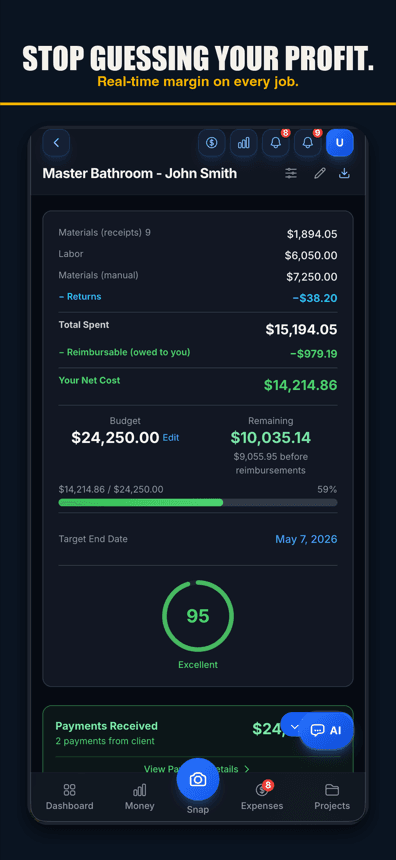
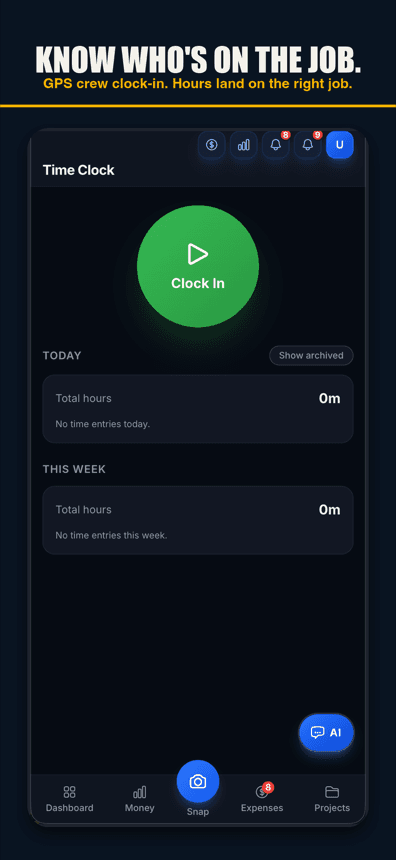
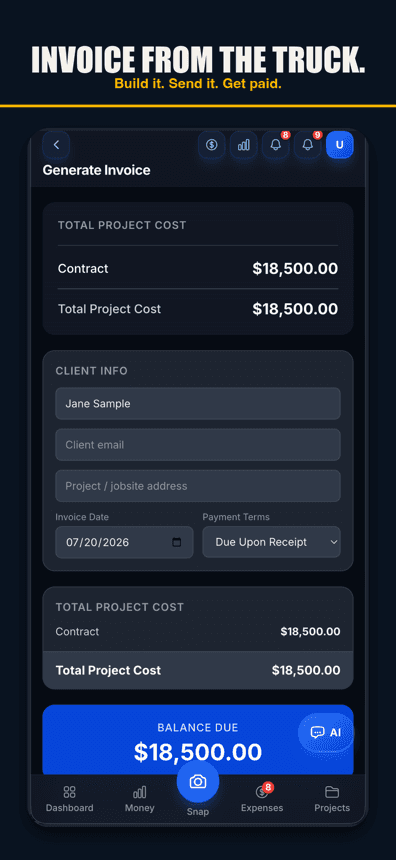
A real iPhone app, free to start
On the App Store, free tier included: 3 active jobs, 50 receipts a month, full AI scanning. A one-truck electrical operation can live on that. No card, no clock.
Get it on the App StoreNew on the App Store — free tier, no card required.
Built for how electrical work spends
Supply-house tickets, job-tagged
Snap the counter ticket and the AI files wire, devices, and breakers on the job that used them — returns netted against the original run.
Licensed and helper hours, split right
Each worker clocks in at their own real cost. The job shows what the labor mix actually did to the margin — not one blended guess.
Margin per job, live
Rough-in, service change, trim-out — each job carries its own running number, so a tight bid that’s going under shows up early.
Free forever — 3 projects, 50 receipts a month. No credit card.
What you get
AI receipt scanning
Line items off supply-house tickets, filed to the job with one tap.
GPS crew time clock
Hours land on the job at each electrician’s real cost.
Live job margin
Charged minus spent, updated as costs land.
Invoicing + payments
Bill from the job’s costs; track what’s owed.
Material returns
The returned breaker credits the same job — no double count.
Worker view
Crew clocks in and submits receipts without seeing your margins.
Voice capture
In the panel? Say the cost and the job — logged. Voice works in browsers with speech input, like Chrome and Safari, and in the iPhone app on version 1.0.8 or newer.
QuickBooks + tax exports
Clean CSV/IIF to your books; a year-end tax package with a list of your receipts.
What an electrical job actually costs
The buckets: wire and conduit by the run (priced the day you bought it, not the day you quoted it), panels, breakers and devices, fixtures the customer picked and the ones they changed, permit fees plus every inspection trip, and labor split honestly between licensed hours and helper hours — because a job that pencils at a blended rate can lose money the day it needs the master on-site twice as long.
Job costing puts each of those dollars on the job that caused it, the day it happens. The trade’s specific trap is material volatility: when copper moves 15% between quote and purchase, only the shops tracking per-job costs know which bids to reprice.
Run the math on a 200-amp panel upgrade
Say the upgrade quotes at $3,600. Panel, breakers, and grounding hardware: $780. Wire and conduit: $340. Permit and one inspection: $220. A licensed electrician six hours at a true cost of $52 and a helper six at $24: $456. Total cost: $1,796 — a 50% margin, solid. Add an unbilled second inspection trip and $160 of material drift, and it’s 44% — still fine, but only honest numbers tell you which bids have room and which are already at the floor.
The example is illustrative math, not a client job — run your own numbers through it and the point makes itself.
What this app is, and isn’t
It is the money layer: job costs, receipts, crew hours, invoices, margins, tax exports. It is not estimating or takeoff software, not dispatch, and not a code reference. Electrical shops that need bid software run it alongside — the quote goes in one tool, and reality gets checked against it here, job by job.
If you’re comparing broader app stacks for the trade, we keep an honest list of the tools electricians actually run — including where each one beats us.
Free tier first
3 active jobs, 50 receipts a month, AI scanning included — free, no card. Pro $29.99/month; Contractor $49.99/month adds unlimited crew seats.
Simple pricing
Less than a single trip to Home Depot.
Start free. Upgrade when you're ready.
Free
3 projects, 50 receipts/month — get started free
- 3 projects
- 50 receipts/month
- AI receipt scanning
- Voice capture (web; iPhone app 1.0.8+)
- 1 tax export/year
- Basic reports
- 3 crew seats: clock in + My Pay
Pro
For small crews — unlimited projects & receipts, 10 crew
- Unlimited projects
- Unlimited receipts
- 10 team members
- AI scans & chat (monthly AI allowance)
- Budget alerts
- Client portal
- Invoice sending
- All exports (tax, CSV, PDF)
Contractor
For crews — unlimited team, auto clock-in & payroll
- Unlimited projects
- Unlimited receipts
- Everything in Pro
- Unlimited team members
- Opt-in automatic clock-in
- Payroll exports
- Custom branding
Paid plans renew automatically at the price shown for the selected interval (monthly or yearly) until you cancel. You'll be charged in US dollars plus any applicable sales tax.
Cancel anytime in Settings → Billing — no refunds for past billing periods. Refund Policy · Terms

Who built this
Chris Sibley — remodeling contractor, Fort Worth, TX
Chris closed a $42,000 bathroom remodel thinking he’d made 30%. His accountant ran the real numbers months later: 12% — $7,500 in receipts never made it onto the job. He built Job Cost Pro so that never happens again, and still runs his remodeling company with it every day. That company is the legal entity behind this app: Salvation Home Remodeling LLC, doing business as Job Cost Pro.
FAQ
What does job costing software do for an electrical contractor?
It tracks every cost a job creates — material runs, devices, permits, inspection trips, and licensed vs. helper hours — against the contract price, per job, so you know each job’s real margin instead of a year-end blend.
Does it separate licensed hours from helper hours?
Yes. Each worker carries their own cost rate; when they clock into a job their hours hit that job at that rate, so the labor mix shows up in the margin honestly.
Can it track material returns to the supply house?
Yes — a return scans like a receipt and nets against the original purchase on the same job, so the job’s material cost stays true.
Is it estimating or takeoff software?
No. It’s the after-the-bid side: what the job actually cost and what you actually kept. Many shops run it next to their estimating tool and compare quote to reality on every job.
Related
No credit card. No demo. No contract.
Price the next bid
off real numbers.
Start freeFree — 3 jobs, 50 receipts a month, AI scanning included.